A Missile That Leaves a Radioactive Trail
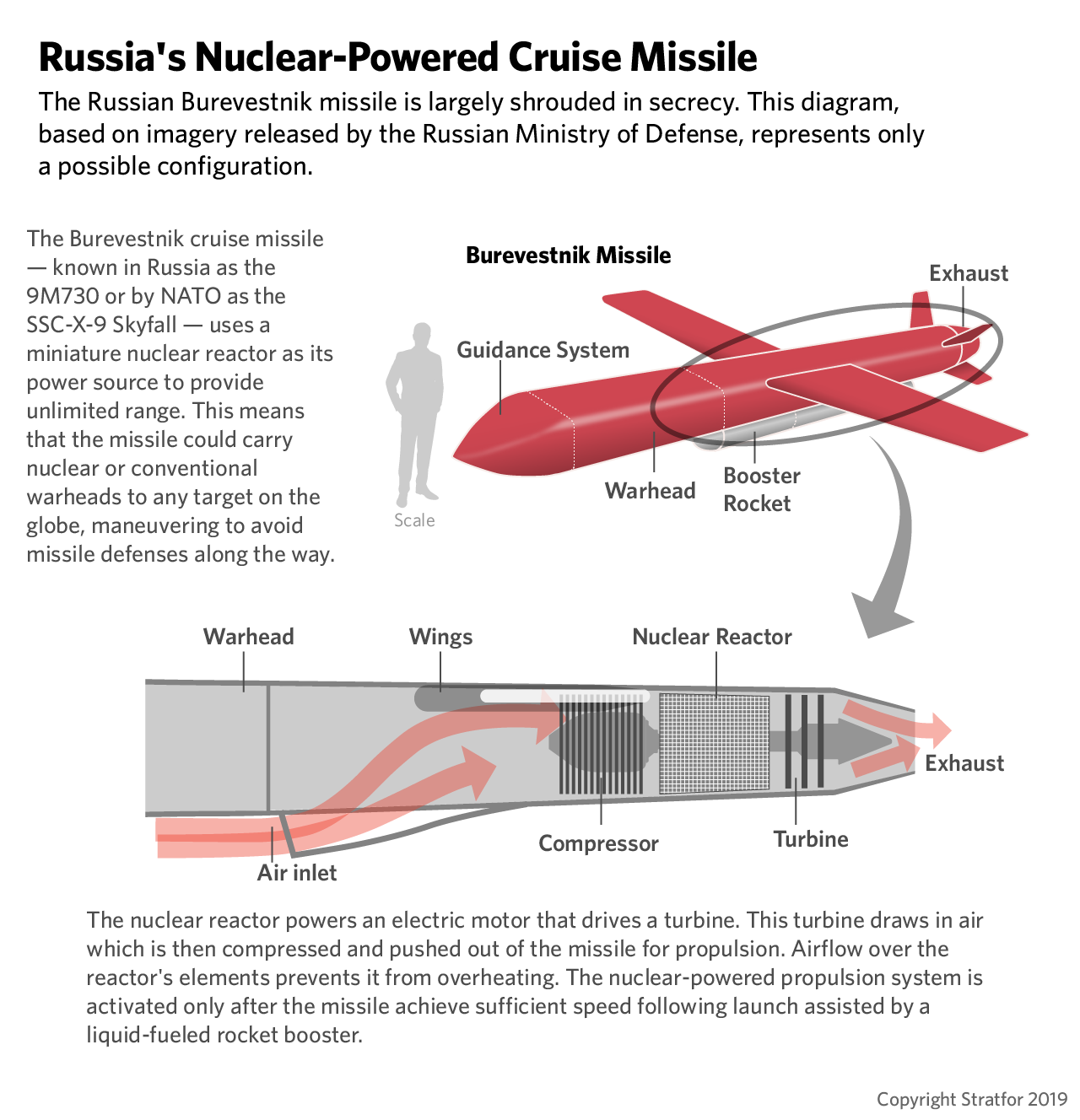
By Jarod ClarkThe Burevestnik’s defining feature is its unshielded nuclear reactor. Instead of chemical fuel, it pulls in outside air, superheats it with the reactor core, and forces it out the back for thrust.
This creates several dire problems:
1. Continuous Radiation Release
Every second of flight would release radioactive isotopes, effectively dusting the Earth along its entire flight path.
- Forests
- Oceans
- Cities
- Arctic environments
Any area the missile flies over becomes contaminated—an environmental nightmare without precedent in modern weapons development.
Even tracking the missile becomes easy because radar isn’t required—its radioactive plume would act as a beacon detectable by satellites and ground sensors. This negates Russia’s claim that the missile is “invulnerable.”
2. Turning a Cruise Missile Into a Dirty Bomb
Even if the warhead never detonated, the propulsion system itself functions like a dirty bomb:
- If it crashes → it sprays reactor fragments over the site.
- If it’s intercepted → it scatters radioactive debris mid-air.
- If it completes its mission → it contaminates its entire route before impact.
This creates global-scale radiological risk that no nation—ally or adversary—wants introduced into the environment.
A History of Failed Tests and Deadly Accidents
Russia’s pursuit of this missile has already resulted in tragic consequences.
The 2019 Nyonoksa Incident
In August 2019, during a reported Burevestnik recovery or test operation, a mysterious explosion killed five nuclear scientists. Radiation levels in nearby Severodvinsk spiked, and residents rushed to buy iodine tablets.
This accident provided the world a preview of what happens when a nuclear-powered weapon fails:
- Immediate fatalities
- Local radiation release
- Secrecy and confusion
- Long-term contamination concerns
Multiple reports indicate the missile has undergone numerous unsuccessful tests, often crashing into the Arctic Ocean—turning parts of the region into an unintentional dumping ground for nuclear components.
Strategically Redundant and Militarily Ineffective
While the Burevestnik is pitched as a “superweapon” with unlimited range, experts across NATO, the U.S. Department of Defense, and Russia’s own retired military community describe it as:
“A science-fiction weapon that adds no real military value.”
Why? Because existing ICBMs already do the job better.
- Traditional ICBMs are faster, reaching targets in minutes—not hours.
- They do not emit radiation and therefore are far harder to detect.
- They already possess intercontinental range.
- Modern ballistic missiles can use decoys and advanced evasion methods without poisoning the planet.
Burevestnik brings zero strategic advantage that conventional nuclear weapons don’t already provide.
And it comes with catastrophic downsides.
The Myth of “Invulnerability”
Russia claims the “Flying Chernobyl” has unlimited range and can maneuver around air defenses. Both claims are technically misleading.

1. It’s Subsonic
Unlike hypersonic weapons, Burevestnik cruises at relatively slow speeds. This makes it vulnerable to:
- Modern fighter jets
- Ground-based air defense systems
- Radar-guided anti-air missiles
Once detected (and again—it self-advertises its position through radiation), intercepting it is not difficult.
2. Unlimited Range ≠ Practical Range
A missile that contaminates everything it flies over cannot be routed over friendly nations or neutral countries without international fallout—literally.
A Weapon Too Dangerous for the Country That Built It
Burevestnik is so hazardous that even Russia appears to fear it. Testing has been sporadic, rarely successful, and deeply secretive. Some analysts believe it may never reach full deployment.
Even the U.S. and Soviet Union abandoned similar nuclear-powered missile concepts during the Cold War—including America’s Project Pluto—because engineers concluded the same thing:
The risk to the environment, global health, and your own population far outweighs any theoretical military benefit.
Conclusion: The Flying Chernobyl Is a Strategic Mistake
Russia’s “Flying Chernobyl” is not a breakthrough.
It is not invisible.
It is not a wonder weapon.
It is a radiological hazard, a strategic redundancy, and an environmental catastrophe waiting to happen.
With every test, crash, or flight, it threatens ecosystems, human health, and global security.
In a world struggling with nuclear contamination, climate challenges, and geopolitical instability, the last thing humanity needs is a missile that spreads radiation simply by existing.