The Vela Incident: 1979’s Mysterious Double Flash and the Nuclear Secrets That Won’t Die
By Jarod Clark
Introduction: Another Nuclear Mystery in the Shadows
On September 22, 1979, a US early-warning satellite recorded what appeared to be the unmistakable signature of a nuclear explosion over the remote southern oceans: a sharp, brilliant flash followed milliseconds later by a dimmer second pulse. This “double flash” pattern had been detected dozens of times before on Vela satellites — every verified instance tied to a nuclear weapons test.
Yet officially, the Vela Incident, also known as the South Atlantic flash, remains “inconclusive.” No nation has ever admitted responsibility, and the US government still withholds key documents more than four decades later.
For a website centered on nuclear catastrophe and transparency, the Vela Incident stands as a critical example of how nuclear events can be hidden, denied, or distorted, shaping global understanding of risk.
What Actually Happened? The 1979 “Double Flash”
The Vela 6911 Detection
- Satellite: Vela 6911, part of the US nuclear test–monitoring constellation
- Time: 00:53 UTC
- Location: Remote South Atlantic/Indian Ocean near the Prince Edward Islands
- Signal: A classic “double flash” consistent with a low-yield atmospheric or near-surface detonation, likely 2–3 kilotons
The detection triggered an immediate response within US monitoring systems. An atmospheric nuclear test in 1979 would have violated international treaties and dramatically altered geopolitical dynamics.
Immediate Investigations
Air Sampling Missions
The US Air Force deployed radiation-sampling aircraft to search for fission products. No definitive fallout was publicly announced, but the missions’ findings remain classified.
Hydroacoustic Data
Underwater listening posts recorded signals consistent with a small explosion near the ocean surface, in the same region indicated by Vela’s orbital detection.
Iodine-131 in Australian Sheep
Routine agricultural monitoring detected elevated iodine-131 in sheep thyroids across southeastern Australia in late 1979 — an anomaly difficult to explain without a recent atmospheric nuclear event in the Southern Hemisphere.
Individually, these findings were inconclusive. Together, they strongly pointed toward a nuclear test.
Who Might Have Conducted the Test?
South Africa’s Nuclear Capabilities
South Africa had an active nuclear weapons program during the late 1970s, though official records state its first complete device was finalized slightly after the Vela detection. Still, infrastructure and political motivations existed.
Israel’s Nuclear Ambiguity
Israel likely possessed nuclear weapons by the 1970s and maintained a strict policy of ambiguity.
A widely supported hypothesis is that Israel and South Africa conducted a joint test:
- Israel supplied the device and technical expertise
- South Africa provided a remote testing ground and logistical support
Declassified fragments of US intelligence assessments suggest this interpretation was considered highly plausible.
The Ruina Panel and the Official “Inconclusive” Stance
In 1980, the Carter administration convened a scientific review led by MIT engineer Jack Ruina. The panel suggested the Vela signal could have been a sensor anomaly — a “zoo event” — caused by a micrometeoroid or other unusual optical artifact.
This conclusion became the public position, despite strong internal dissent within US intelligence agencies and scientific institutions.
Private assessments from the era:
- Estimated the likelihood of a nuclear test as over 90%
- Identified acoustic and atmospheric indicators consistent with a detonation
- Noted that the bhangmeter signature was virtually identical to confirmed past tests
Even President Carter wrote in personal notes that scientists increasingly believed the event was a secret Israeli test.
Why the Vela Incident May Never Be Fully Declassified
1. Israel’s Nuclear Ambiguity
Confirming the test would publicly acknowledge Israel’s nuclear arsenal — contradicting decades of US policy.
2. South African Historical Sensitivities
Revealing deeper collaboration could reopen political, diplomatic, and historical debates about the apartheid-era weapons program.
3. Protection of Intelligence Methods
Full disclosure would reveal sensitive details about:
- Satellite optical technology
- Hydroacoustic detection networks
- Atmospheric sampling capabilities
4. Domestic Political Implications
A definitive conclusion could reveal that political motivations influenced public statements during an election year.
5. International Treaty Complications
A confirmed atmospheric test in 1979 would highlight flaws in the Partial Test Ban Treaty's enforcement mechanisms.
For these reasons, essential documents remain classified or heavily redacted.
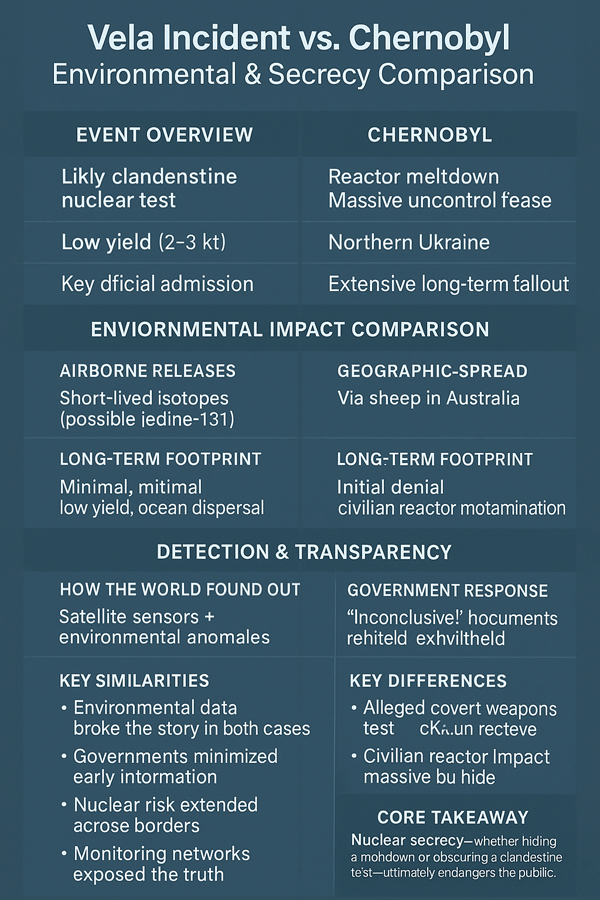
Environmental Impact Comparison: Vela vs. Chernobyl
While the Vela Incident and Chernobyl were vastly different in scale and cause, they share important environmental and thematic connections.
1. Atmospheric Release of Radionuclides
Chernobyl
- Released enormous quantities of iodine-131, cesium-137, and other isotopes
- Contaminated large areas of Ukraine, Belarus, Russia, and Europe
- Resulted in long-term exclusion zones and enduring health impacts
Vela Incident
- If the flash was a nuclear test, it would have released short-lived isotopes such as iodine-131
- The primary indication of fallout was the elevated iodine-131 detected in Australian sheep thyroids
- No long-term contamination zone exists due to the small yield and location over open ocean
Both cases demonstrate that airborne radionuclides travel far beyond their source, crossing borders and appearing in biological systems.
2. Detection Through Environmental Monitoring
Chernobyl
The Soviet Union attempted to hide the accident; the world learned of it when Swedish nuclear workers triggered radiation alarms.
Vela
No nation admitted responsibility. Environmental anomalies — especially in Australia — were among the few public clues.
In both cases, independent monitoring exposed a nuclear event governments sought to downplay or conceal.
3. Attribution and Transparency
Both Vela and Chernobyl are examples of:
- Governments withholding information
- Delayed or incomplete disclosures
- Scientific evidence contradicting official narratives
Chernobyl’s environmental data became public immediately. Vela’s remains partially hidden.
4. Long-Term Environmental Footprint
Chernobyl
- Significant long-term contamination
- Creation of a 1,000-square-mile exclusion zone
- Ongoing mutations, bioaccumulation, and soil contamination
Vela Incident
- Likely minimal long-term environmental impact due to:
- Low explosive yield
- Remote ocean location
- Predominance of short-lived isotopes
Yet the true environmental consequences cannot be fully evaluated because key technical data remain classified.
5. Thematic Parallels for Chernobyl-Focused Readers
- Both incidents were revealed by environmental evidence, not government transparency.
- Both reveal how political interests can shape nuclear narratives.
- Both illustrate how nuclear events — whether accidental or intentional — have international environmental implications.
- Both highlight the necessity of independent, global environmental monitoring.
What We Know Today
Most independent experts believe that:
- The Vela signal was a genuine nuclear test
- Israel was likely involved, with South African support
- Internal US analyses aligned with this conclusion
- The official “inconclusive” stance was driven by politics, not science
But without full declassification, the final truth remains hidden.
Conclusion: A Warning for the Nuclear Age
The Vela Incident is a reminder that nuclear risks are not always explosive disasters like Chernobyl. They can also be quiet flashes over remote oceans, hidden within classified documents and political decisions.
Whether a small test or a sensor anomaly, the Vela Incident teaches the same lesson Chernobyl carved into history:
Nuclear secrecy protects governments — not the public.
Understanding events like Vela helps the world recognize how political motivations shape what we are allowed to know about nuclear risks.
Consolidated Reference List
(For developer use: add outbound links as needed.)
Primary Government & Scientific Sources
- CIA Vela Incident Memoranda (1979–1980, declassified)
- Naval Research Laboratory hydroacoustic studies
- Jack Ruina Panel Report (1980)
- White House Diary of President Jimmy Carter
- US Air Force atmospheric sampling mission logs
- State Department nonproliferation files (Gerard C. Smith papers)
Research Institutions
- National Security Archive
- Wilson Center: Nuclear Proliferation International History Project
- Federation of American Scientists (FAS)
- Independent academic analyses of bhangmeter detection physics
Environmental Data Sources
- Australian CSIRO studies on iodine-131 in livestock
- Atmospheric transport modeling studies for 1979–1980
- Comparative assessments of nuclear test fallout vs. reactor fallout